xiongjianghui.com
From the First Principles of Life, Exploring Biomedicine's New Language, New Models & New Paradigms
Method Scarcity
生物医学被困在归纳法里200年。AI可以改变这一点。
归纳法AI
起点
数据 → AI找模式 → 人类解释
输出
更好的工具
本质
加速现有流程
现状
已被广泛探索
演绎法AI
起点
原理 → AI推导 → 数据验证
输出
新的知识生产方式
本质
重构整个框架
现状
几乎空白
演绎法AI是AI在生命科学领域的终极应用——不是帮人类更快地做旧事,而是帮人类做一件从未做过的事。
Demonstrations
演绎法真的可行吗?三个维度的证明。
分子尺度的顶刊验证
“环境→能力储备变化”已被顶刊证实
Nature 2024:线粒体根据ATP需求动态分化为两个功能亚型。Cell Metabolism 2024:棕色脂肪形成表观遗传记忆
从检测到生成的完整能力栈
能力组学驱动的长寿科技
检测:3000维度空间高精度衰老表征。分析:Capome衰老大模型识别10种衰老疾病。生成:SEMO引擎生成个性化干预方案
Working System
不是思想实验,是已经工作的系统。
最小可验证系统已搭建,正在持续放大。
Strategic Value
对于AI公司,这意味着什么?
战略卡位
AI在生命科学领域的下一波浪潮,不是更好的预测工具,而是新的知识生产方式。谁先建立'演绎法AI'框架,谁就定义了下一代生物医学的基础设施。
差异化竞争
DeepMind有AlphaFold(归纳法),OpenAI有GPT(归纳法)。还没有人做'从第一性原理演绎整个医学知识体系'——这是空白。
可落地验证
不是纯研究。已有3000+数据、合作伙伴、检测产品。演绎框架已被证明能产生有效干预。
Blog
Latest Posts
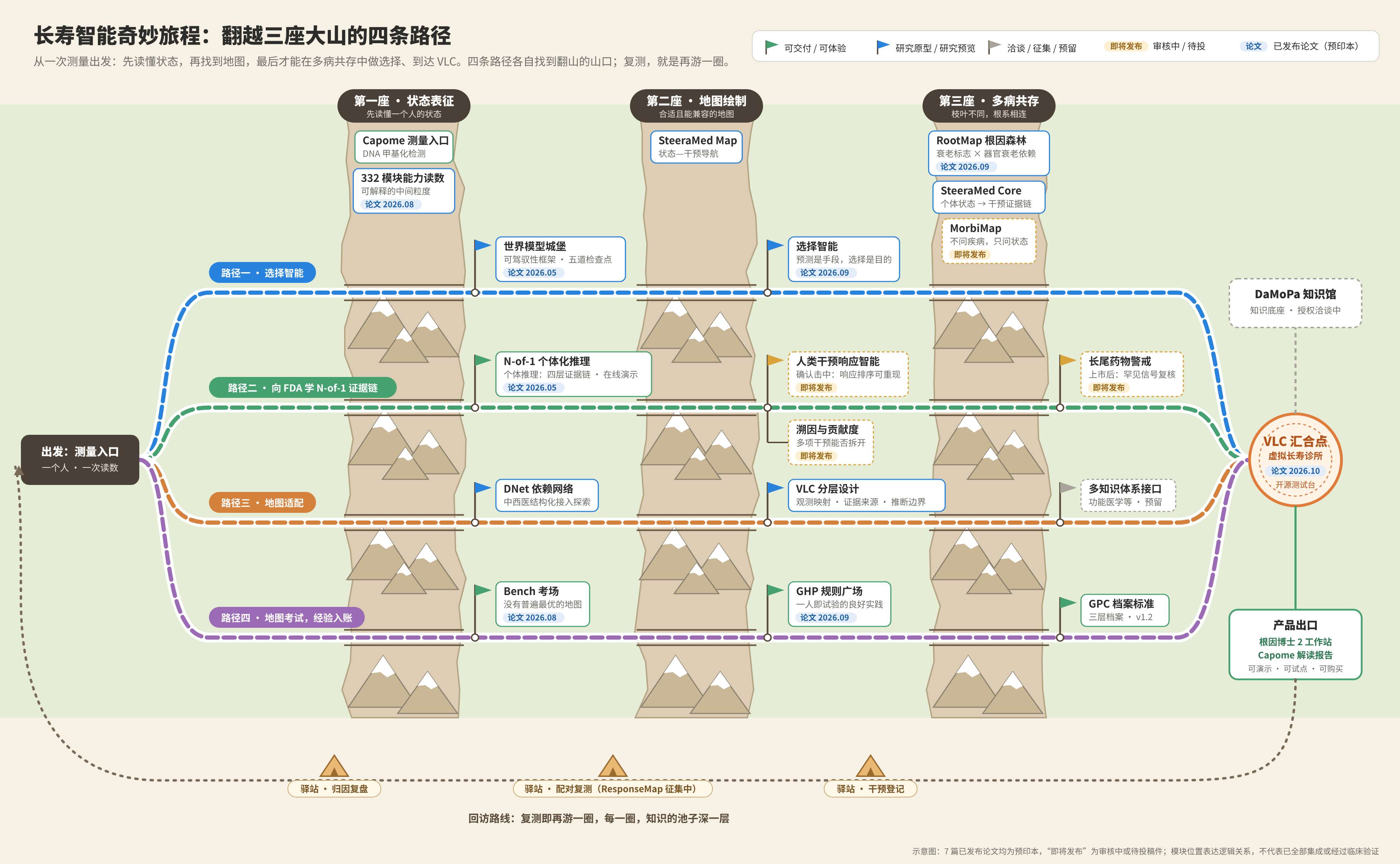
DeepoMe's Jianghui Xiong: Three Mountains and Four Paths to Longevity Intelligence
Longevity intelligence faces three mountains — state representation, map making, and multimorbidity — and four paths across them: selection intelligence, an FDA-style N-of-1 evidence chain, map adaptation, and testing maps while banking experience. Prediction is the means; selection is the end. VLC is where the four paths meet: a research prototype and software testbed, not a clinical decision system.
The Next Stage of Aging Detection: Why It Is the Life World Model
The competition over detection accuracy has largely fulfilled its mission. The next stage of longevity medicine is the Life World Model, bringing two new capabilities: abduction (inferring root causes from phenotypes) and counterfactual reasoning (simulating outcomes before intervention). The path unfolds in three steps: build the ruler (high-precision biological age testing), draw the map (multi-dimensional aging atlas), and construct the life world model. DNA methylation serves as the data substrate for its robustness, accessibility, universality, and proximity to root causes — a single methylation test can reproduce multi-omics information (r = 0.92). The real bottleneck is not larger model parameters but real-world longitudinal paired data, which can only grow out of the detect-intervene-retest-iterate loop.
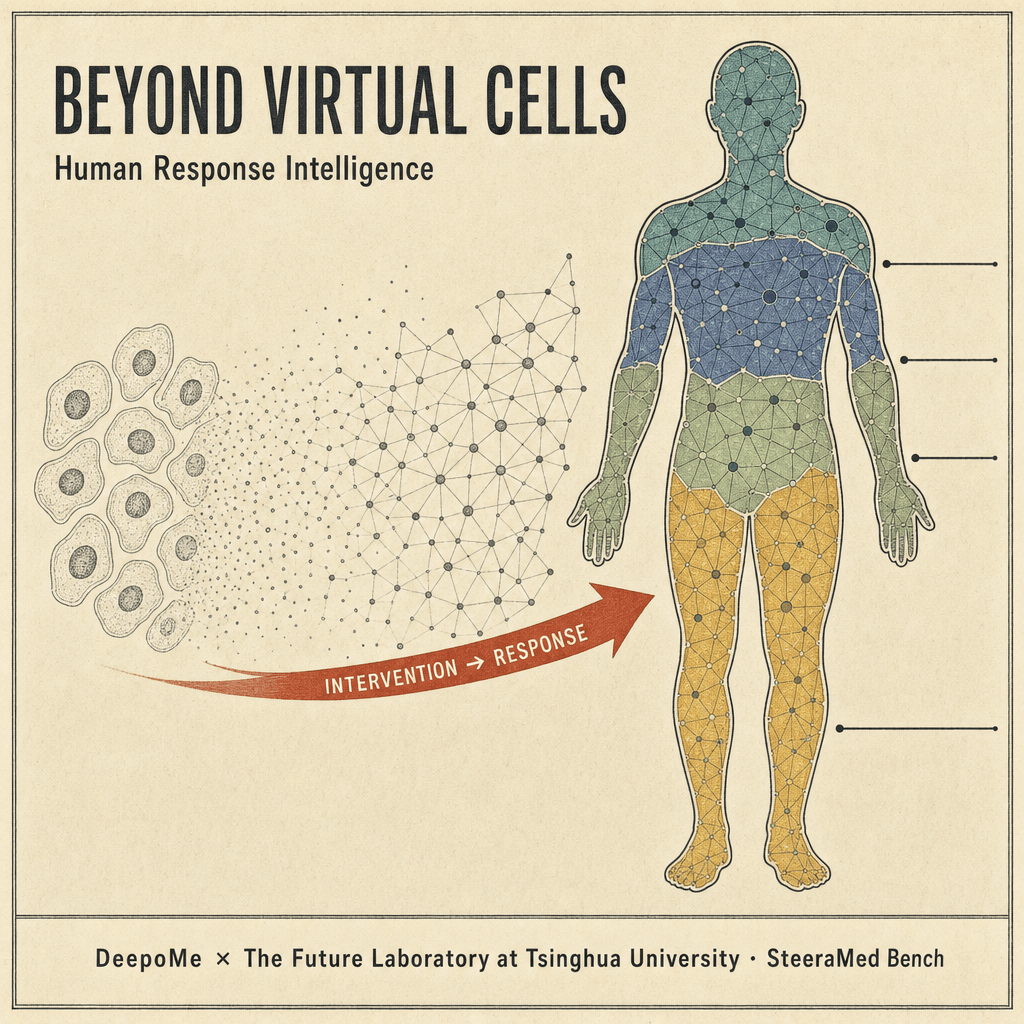
From Virtual Cell to Virtual Patient: The Missing Layer in Between
The virtual cell is having its moment: a Cell paper by forty-plus authors proposed building an AI Virtual Cell with multi-scale foundation models. But a patient is not a bigger cell—from cell to human body lie multiple emergent transitions, where pathway redundancy and patient heterogeneity keep making 'works in vitro' end at 'fails in vivo'. This essay argues that the path from virtual cell to virtual patient is missing not a bigger model, but a map at another scale—the 'molecule → module → human' conversion layer—and that virtual patients require two things virtual cells cannot offer: the medical semantics of Action (will this person respond to this intervention?) and a re-test feedback loop (predict → intervene → re-test → correct). The essay closes with the economics: the Phase II valley of death, ~$0.9 billion per approved drug, and biomarker stratification halving costs—the key is not under the streetlight.
FAQ