DeepoMe's Jianghui Xiong: Three Mountains and Four Paths to Longevity Intelligence
Longevity intelligence faces three mountains — state representation, map making, and multimorbidity — and four paths across them: selection intelligence, an FDA-style N-of-1 evidence chain, map adaptation, and testing maps while banking experience. Prediction is the means; selection is the end. VLC is where the four paths meet: a research prototype and software testbed, not a clinical decision system.
A conversation with Dr. Jianghui Xiong, Chief Scientist at DeepoMe · Interview and editing by Akang
The "post-AI era" does not mean AI is leaving the stage. It means AI has become infrastructure, like electricity or running water: general intelligence is getting more plentiful and cheaper every month. When intelligence stops being scarce, the bottleneck in the life sciences is no longer how fast we can compute. It is whether we are willing to step outside the old frameworks and think differently. That shift is opening a remarkable journey for AI in the life sciences, and longevity medicine stands at its entrance.
On October 6, DeepoMe released a new paper, The Virtual Longevity Clinic: A Versioned State-Map Framework and Software Testbed for Biomedical World Models (VLC, preprint). We used the occasion to spend an afternoon with Dr. Jianghui Xiong, starting from this paper and the ones that came before it. Dr. Xiong works across biology, specialty medicine and computer science, and he increasingly thinks of himself as an architect of longevity medicine: with AI, he first builds an engineering system where components can plug in, be tested and be improved, and then studies the components one by one inside that system.
Questions we explore:
- What are the three mountains of longevity intelligence?
- Why is "prediction the means and selection the end"? And why does Jev, a model that has drawn recent attention, only answer multiple-choice questions?
- The FDA has opened a path for drugs made for a single patient. What can longevity medicine learn from it?
- Can aging biology, functional medicine and traditional medicine plug into the same map?
- Elon Musk says future discovery "rounds up to 100% engineering." Is longevity medicine a science problem or an engineering problem?
- How far along is DeepoMe's roadmap, and where can you try it yourself?
Start from capability
Dr. Xiong's path is unusual: a bachelor's degree in biology, a master's in specialty medicine, a PhD in computer science, and 21 years of research in space medicine. He describes what each field gave him:
"Biology taught me to understand life. Specialty medicine taught me how the human body adapts to different environments. Computer science let me turn those questions into models we can compute. Crossing so many fields, I got used to looking at the overall structure first and the local details second."
Over time, he became convinced that it is more useful to ask how much capability a person still has than to describe which diseases they have. That idea grew into Capomics (capability omics). It starts from a first principle, a bottom-level claim that does not depend on other assumptions: life is a collection of capabilities for adapting to the environment.
Why call this the post-AI era? Because AI is turning from a scarce skill into everyday infrastructure, and the cost of reasoning and analysis keeps falling.
"In the past we were limited by computing power and analytical capacity, so many ideas stayed on paper. Now the bottleneck has moved: which state of a person do we read, which map do we use, which choice do we make, and what counts as evidence? You cannot solve these by adding more compute. But abundant intelligence gives us the confidence to think out of the box."
Where VLC fits
The "Virtual Longevity Clinic" is a junction on this road. VLC is a research prototype of an AI agent built for N-of-1 settings in longevity medicine. N-of-1 means a sample size of one: you study a single person and use that person's own before-and-after changes as the comparison. VLC is currently a research prototype and software testbed, not a clinical decision system[1].
The DeepKang website hosts a "park guide map" that places DeepoMe's 7 published papers and 17 engineering modules on a single route. The version below is simplified and redrawn for this conversation. You start from one measurement. Three mountains block the way. Four paths each find their own pass across, and all of them meet at VLC.
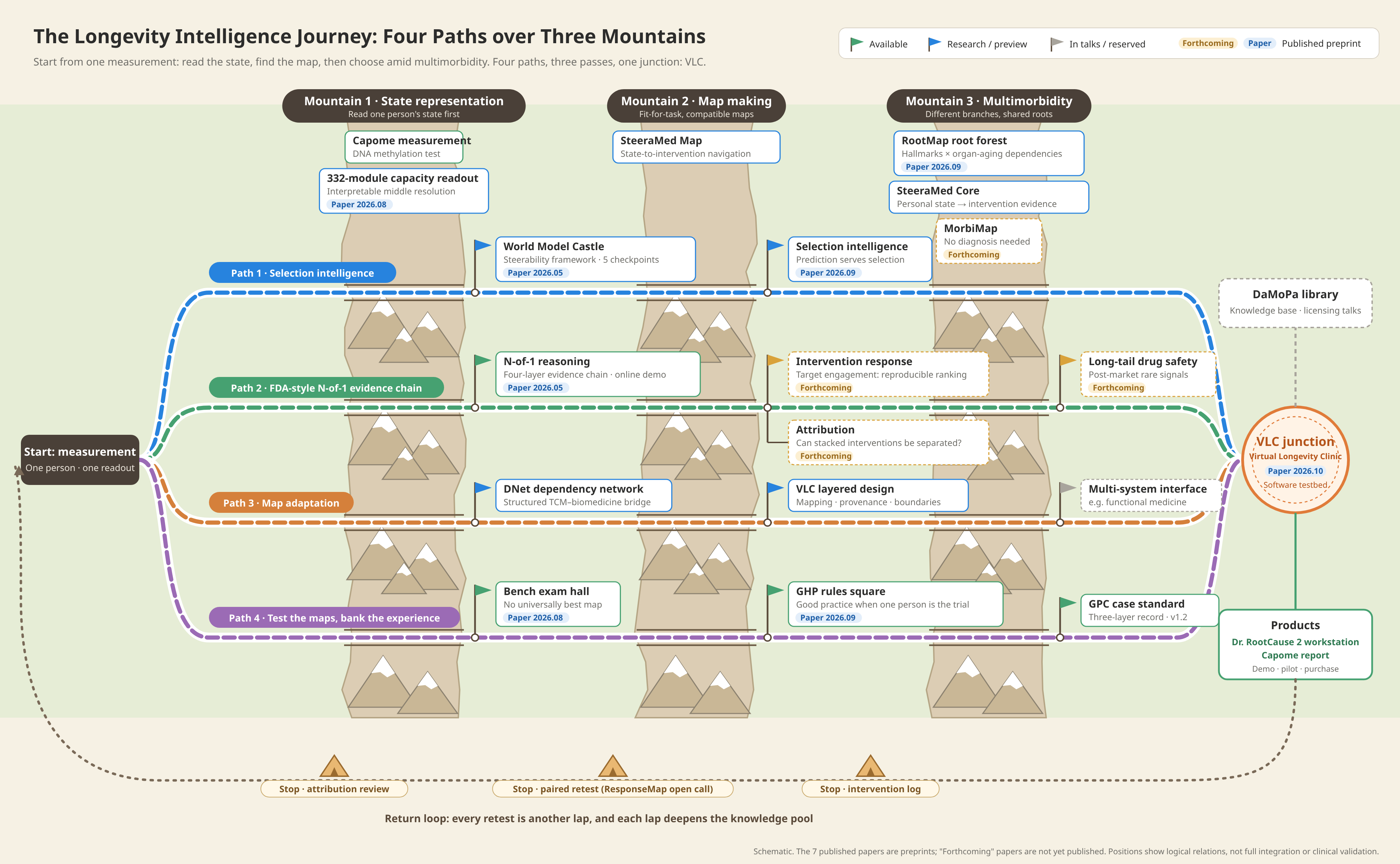
"The flag colors show maturity: green is available now, blue is still in research, gray is in talks or reserved. A blue 'Paper' tag marks a published paper; all of them are preprints. An orange 'Forthcoming' tag marks papers under review or being prepared for submission. Every retest is another lap around the park."
The landscape: where today's world models stop
"World models" are a hot topic. In biomedicine, Dr. Xiong sees roughly four routes:
- Virtual cells. Simulators trained at the cell level on many kinds of molecular measurements, such as gene expression (multimodal omics), to predict how a cell will respond to "perturbations" like drugs or gene editing[2]01332-1). The first Arc Institute Virtual Cell Challenge drew more than 5,000 registrants and over 1,200 team submissions.
- Medical digital twins. A virtual "digital double" for each person that simulates their physiology and disease. The hard parts are getting the data and validating the model[3].
- Knowledge graphs and biological foundation models. The first link known relationships among genes, diseases and drugs into a large network; the second pre-train general models on massive biological datasets. Both are huge in scale, but the strength of their evidence varies widely.
- LLM agents. Strong at dialogue and reasoning, but they usually do not keep an explicit record of a person's state, and they cannot say where the evidence behind a conclusion ends.
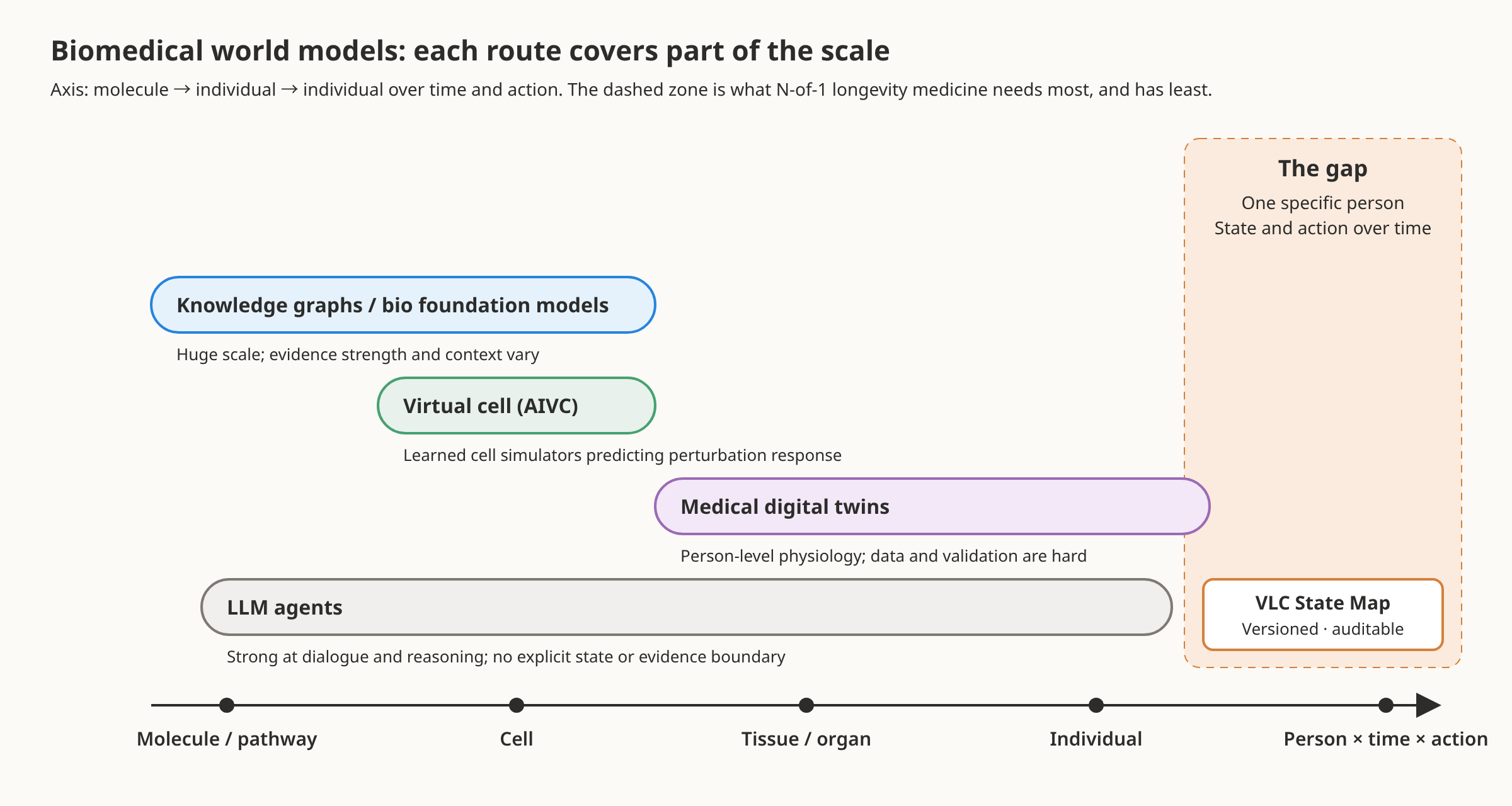
"These routes complement each other, but they all leave the same gap: one specific person, their state and their actions over time. That is exactly the segment longevity medicine needs."
Three mountains
To reach that segment, three mountains must be crossed: state representation, map making and multimorbidity. The order matters. Multimorbidity is why many people set out, yet it is the last mountain. You first have to read a person's state, then find the right map, and only then can you make choices amid multiple diseases.
Mountain 1: State representation
How do you read a person's "state"? There are already plenty of aging clocks.
"Testing is moving faster than decision-making. We can measure more and more, but 'what do we do after the test?' has not kept up."
A single biological-age number from an aging clock cannot tell you what to do first and what to do next. Piling every marker into the model loses interpretability. What is needed is a middle resolution: finer than one number, coarser than tens of thousands of markers; biologically meaningful, yet readable from an individual's test data.
DeepoMe currently uses 332 named gene modules, read out from Capome's DNA methylation test. (DNA methylation is a type of chemical mark attached to DNA. It does not change the gene sequence, but it shifts with age, environment and lifestyle, so it can serve as a "readout" of the body's state.) Each module is a group of functionally related genes that yields an interpretable capability reading. The modules fall into 11 families, including hallmarks of aging, organ systems, metabolism, immunity and nutrient response[4].
Mountain 2: Map making
With a state readout in hand, what makes a map the right map?
"Bigger is not better. The protein interaction maps used in network medicine record which proteins physically interact, for example by binding each other. They don't directly tell you what that means for health."[4]
A suitable map should be useful for the task, testable on public standard tests (benchmarks), traceable through every revision, and explicit about the source, evidence strength and limits of every relationship it contains.
The harder problem is compatibility. Aging hallmarks, organ systems, functional medicine, nutrition and exercise science, and even traditional medicine each have their own concepts and experience. Even the next mountain, multimorbidity, has no agreed definition: prevalence estimates in older adults range from 4.8% to 93.1%[5]. Forcing everything into one framework throws away a great deal of knowledge. Letting each system speak its own language makes comparison and accumulation impossible.
Mountain 3: Multimorbidity
About 37.2% of adults worldwide live with multimorbidity, and among people aged 60 and older, more than half have two or more chronic conditions[6]00037-8/fulltext). Yet health care is organized one disease at a time: one specialty, one guideline, one set of markers. Stack those onto a single person and you get duplicate tests, piled-up prescriptions and conflicting goals. Longevity medicine clients often run five to ten interventions at once, and a year later it is hard to say which one worked[4]. Path 2 below takes on that accounting problem.
Aging biology offers another lens. The 2023 update of the "hallmarks of aging" framework lists 12 interconnected classes of mechanisms[7]. Different branches, connected roots. The question changes from "which diseases does this person have?" to "what state is this person's system in, and where is the best place to intervene first?" Answering it draws on the first two mountains: first a state readout, then a map that can see the roots.
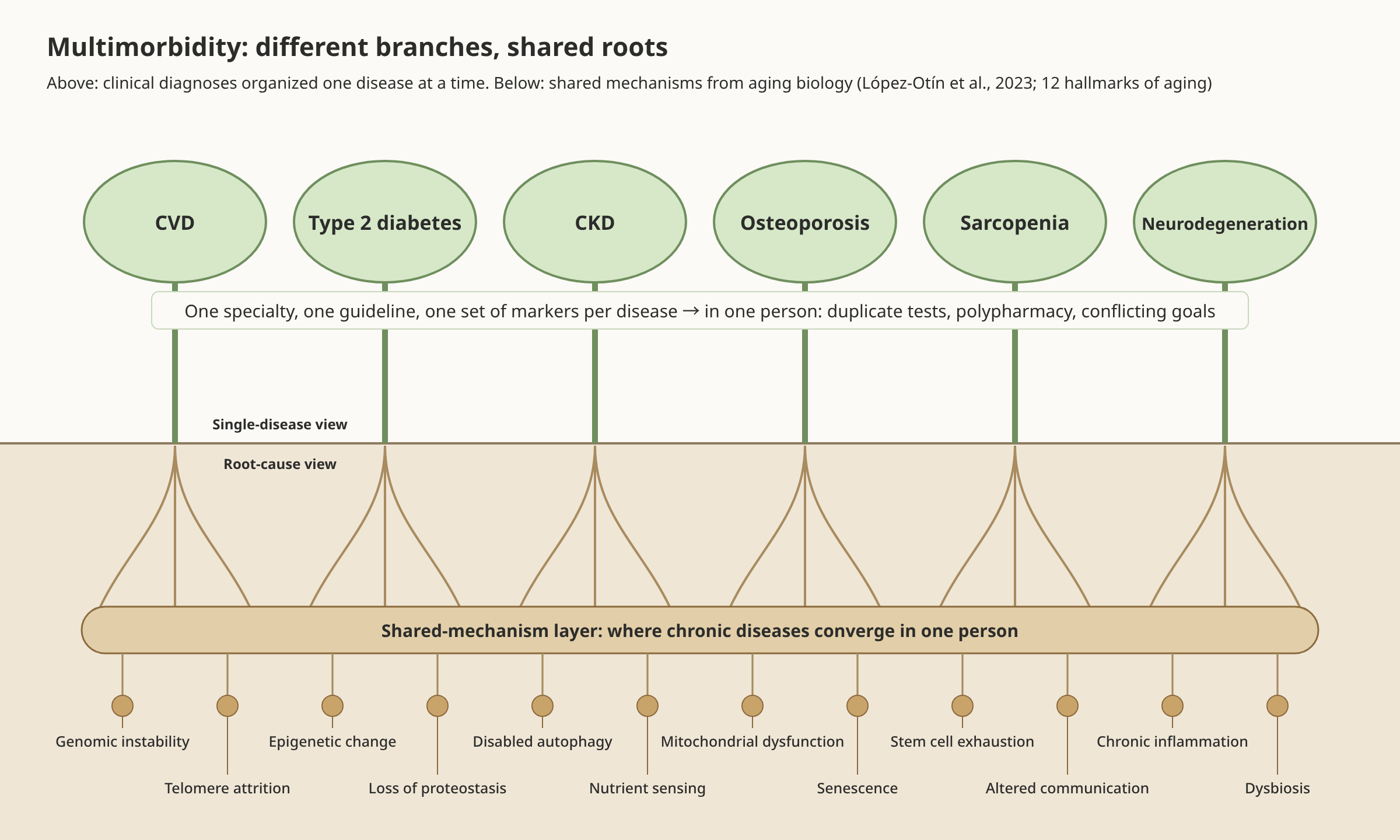
DeepoMe's forthcoming MorbiMap paper tests this route. Instead of labeling a person with diseases first, it ranks candidate drugs directly from the person's module state. Early results show a positive signal: in hypertension data, the top 20 included 6 blood-pressure drugs, compared with about 2.4 on average for a random ranking[8]. The study has not yet tested treatment response, so the ranked drugs are research candidates; their efficacy has not been tested.
Four paths
Mountains identified, how do we cross them? Dr. Xiong proposes four paths, and none of them starts from "bigger models, more data." The three mountains are the obstacles; the four paths are the ways across. They also answer the bottlenecks named earlier:
- Selection intelligence answers which choice to make.
- Learning N-of-1 from the FDA answers what counts as evidence.
- Map adaptation and testing the maps together answer which map to use. The first lets maps from different knowledge systems plug into the same personal record; the second tests which ones work and lets experience accumulate.
- Which state to read is the job of the first mountain.
Path 1: Selection intelligence. Prediction is the means; selection is the end
One of DeepoMe's late-September papers carries a title that reads like a slogan: Prediction Is the Means, Selection Is the End. To understand it, start with the two preprints DeepoMe has written on steerable world models. "Steerable" means a model should not only predict what will happen, but also guide which direction to intervene in, and where to stop.
The first, World Models for Biomedicine: A Steerability Framework, sets five constraint checkpoints for biomedical world models: state clearly which state is being described, how it is quantified, how it should change after an intervention, and how it evolves over time, and then pass one final check as a whole. When a prediction fails, you can locate which checkpoint broke, so failure itself becomes a diagnostic signal[9].
The second, Prediction Is the Means, Selection Is the End, goes further. Intervention decisions do not need a more accurate "next-state prediction"; they need a better selection: for this person, at this moment, which action to take. So you study predictability before prediction, asking first whether the thing can be reliably predicted at all: under which representations and conditions can intervention response be read reliably? Negative results are valuable in their own right, because they mark the zones where you should not act. The deliverable is not a bigger predictor but a steering framework with four parts: constraints, intervention semantics, goals and boundaries[4].
The Jev analogy
"Selection versus prediction" recalls Jev, a model that has drawn recent attention. Jev is a "System 1 model" launched by TypeSafe AI in September 2026 ("System 1" refers to fast, intuitive judgment). It does one thing: answer multiple-choice questions. It does not predict the next word or hold a conversation. It picks the answer directly from predefined options and attaches a calibrated probability to each one. "Calibrated" means that among all the judgments labeled 90% confident, about nine in ten are actually correct.
"That is consistent with how we think about world models. The mainstream approach asks a model to predict the next state or to generate a paragraph of advice. We think an intervention decision is, at its core, a multiple-choice question: given a person's state map and a list of candidate interventions, which one do you choose, how confident are you, and when should you hold back? Prediction is only a means to the choice."
VLC is built this way: its recommendations must map back to candidate options given in advance. That is partly achieved today. In replay tests, 29 of 32 recommendations mapped back to the given options[1].
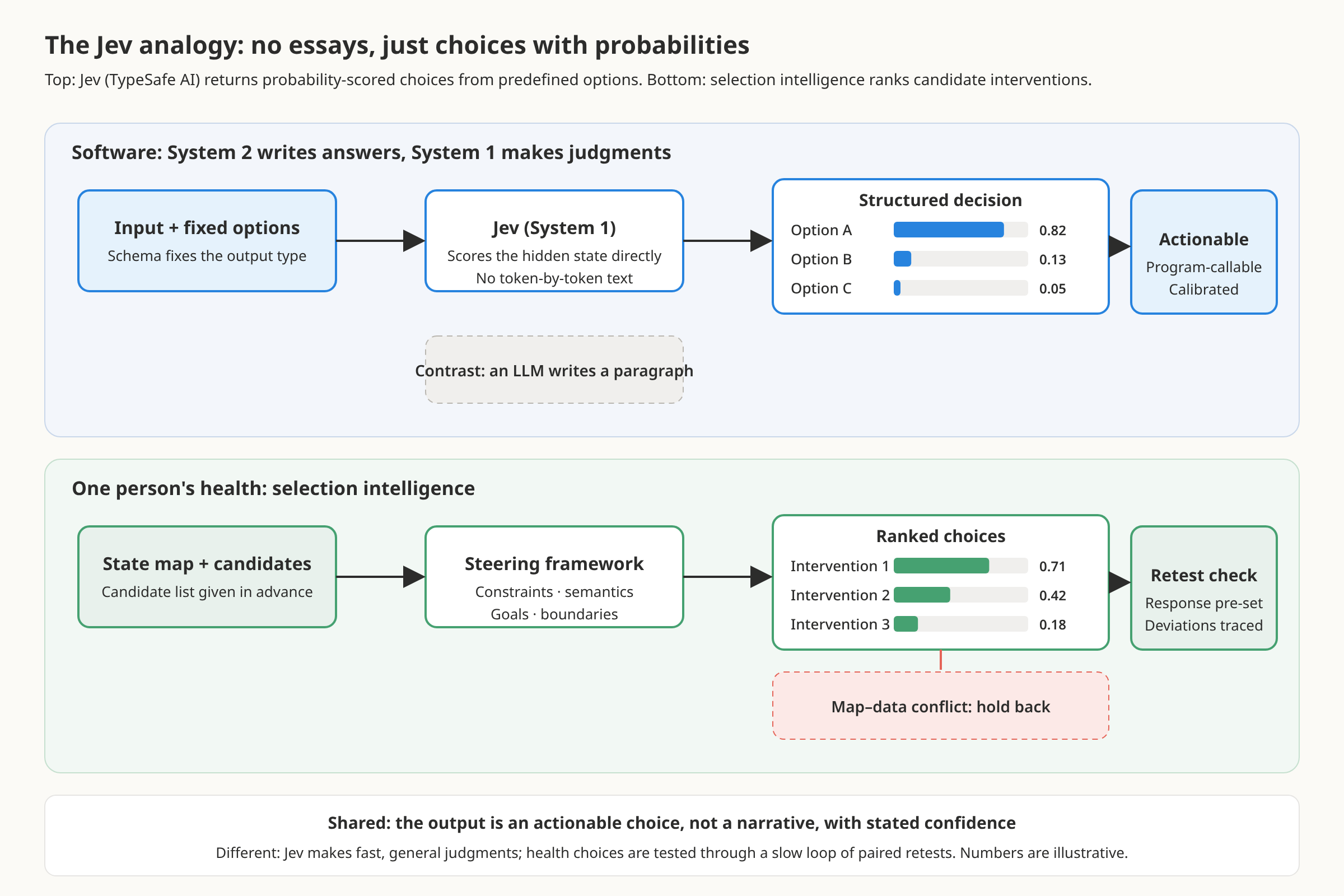
The difference lies in the feedback loop. Jev makes fast, general judgments. Health interventions must be checked through a slow loop: measure once before and once after, and compare the two (paired retesting). Long-term, repeated intervention records from the same person (longitudinal data) are scarce in biomedicine. So DeepoMe first writes existing biological knowledge into an explicit structure, then uses paired observations to calibrate, revise or reject it. Structure does not replace longitudinal evidence; it narrows the range of hypotheses that scarce data has to test[4].
"I like the image of a shepherd. A smart shepherd doesn't map the whole grassland before moving the flock. He first works out where the water and grass are, and where the wolves and deserts are, then plans a safe route. In longevity medicine, water and grass are the zones where evidence is reliable and action is worth taking. Wolves and deserts are where prediction is unreliable and you should not act."
Path 2: Learning N-of-1 from the FDA
Is there a regulatory precedent for N-of-1? Yes, and it is instructive.
In 2019, a team at Boston Children's Hospital designed a custom antisense oligonucleotide drug, milasen, for a child with CLN7 Batten disease, a fatal, rare, inherited neurodegenerative disease. Drugs of this class are short synthetic strands of nucleic acid that correct the expression problem of a disease-causing gene in a targeted way. It took about a year from diagnosis to the first dose[10]. In 2021, the FDA issued draft guidance on how to file clinical research applications for individualized antisense drugs intended for one or a small number of patients. In November 2025, FDA leadership described a "plausible mechanism pathway" in the New England Journal of Medicine. Its elements are: a clearly defined molecular or cellular abnormality; an intervention that acts on that abnormality or the pathway immediately upstream; the natural history of untreated patients (how the disease progresses without treatment); evidence that the drug's target was successfully engaged; sustained improvement consistent with the disease biology; and continued collection of real-world evidence after approval[11].
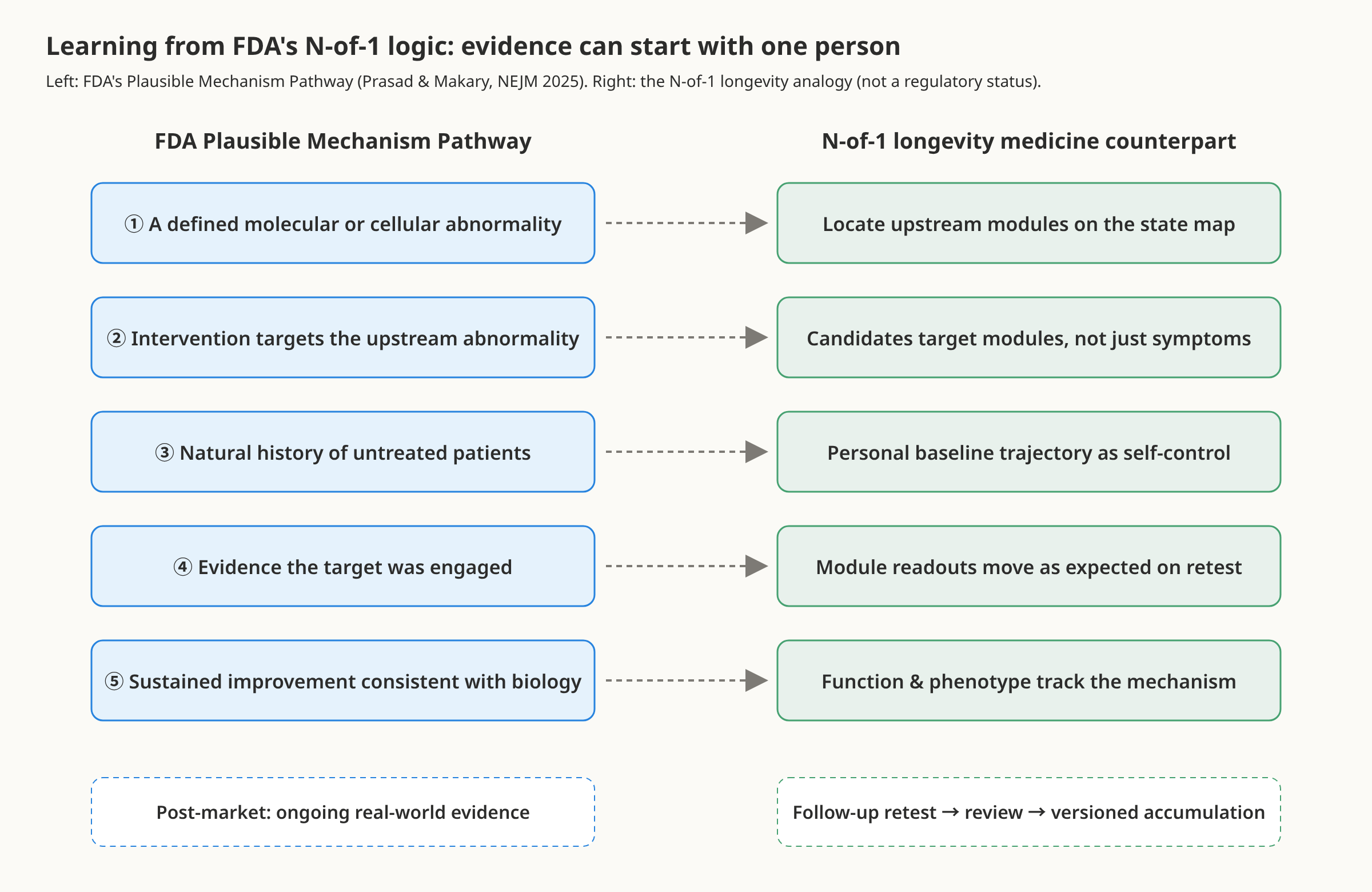
This pathway is designed for rare diseases with clear causes and cannot be transplanted directly into longevity medicine. But its evidence logic is worth learning: mechanism first, aim at the upstream cause, use natural history as the comparison, confirm the target was hit, check that improvement matches the mechanism, and keep tracking after approval. In longevity medicine, a person's own baseline trajectory can act as their control. If module readouts move in the expected direction on retest, that is preliminary evidence of a "hit," but it still needs confirmation from improvements in function and phenotype.
DeepoMe has a relay of papers along this evidence chain, each covering one link:
- Individual reasoning. The published SteeraMed paper starts from one person's molecular state and reasons along a four-layer evidence chain to candidate interventions. It has been validated retrospectively in four diseases[12]. The remaining links are forthcoming papers, previewed here.
- Confirming the hit. The forthcoming Human Intervention Response Intelligence paper (VPR) analyzes 8 intervention cohorts and 248 pairs of before-and-after blood methylation data. Pre-intervention baselines cannot yet predict who will respond or by how much. But after an intervention, the ranking of which modules changed most was reproducible in 5 of 7 evaluable cohorts. In plain terms: split a cohort randomly into two halves, and both halves produce largely the same list of "most-changed modules"[13]. At this stage, it is easier to see which modules a type of intervention tends to change than whether a particular person will respond. This cannot yet be used to choose treatments for individuals.
- Attribution. Longevity clients often stack several interventions at once. Another forthcoming paper audits whether the combined methylation change can be decomposed back to each intervention. The preliminary answer: it depends on how many interventions are combined and how noisy the data are. In simulations with moderate noise, up to three interventions could still be separated. This is an audit of the data, not proof of clinical attribution[14].
- Post-approval tracking. Mirroring the FDA's post-market follow-up, the forthcoming long-tail pharmacovigilance paper uses semaglutide and NAION (an ischemic disorder of the optic nerve) as a case to ask whether rare adverse-event signals can be detected and reviewed, and how much language models can see. The preliminary finding: what models can see depends on the data[15].
Path 3: Map adaptation. Letting every knowledge system contribute
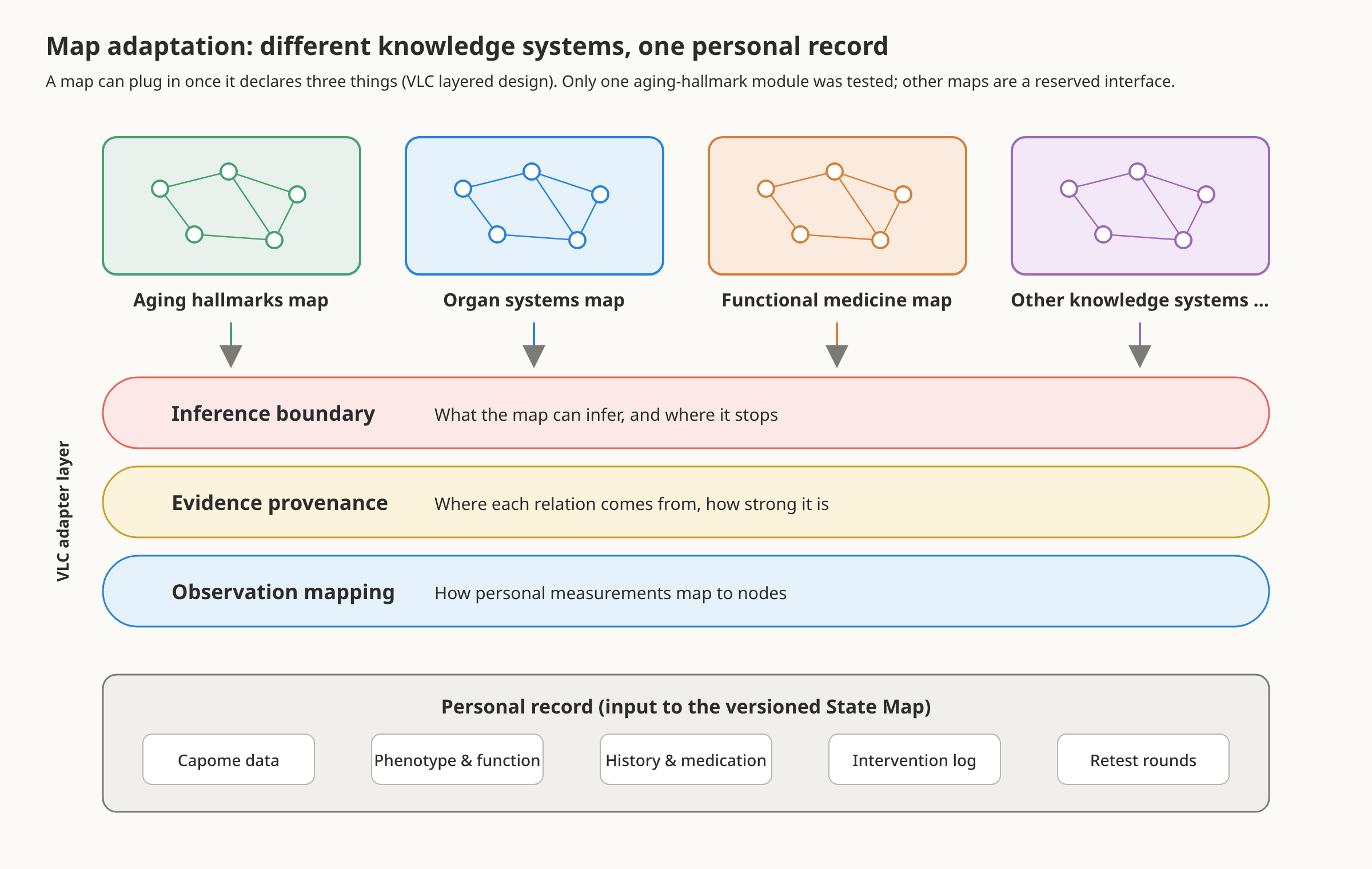
How do you make incompatible knowledge systems work together? Dr. Xiong's answer: don't draw one "map of truth"; design the map interface.
To plug in, a map must declare at least three things: how personal measurements map onto its nodes, where its relationships come from, and where its inferences stop. VLC separates exactly these into independent layers: observation mapping, evidence provenance and inference boundary[1]. Once these are declared, aging hallmarks, organ systems, functional medicine and even the experience of traditional medicine can all connect to the same personal record, where they can be compared and can complement one another. DeepoMe's DNet dependency network is an attempt to place traditional Chinese medicine and modern biomedicine on the same computable module map. It is an exploration of structured integration, and it does not claim the two theories are equivalent.
Path 4: Test the maps, bank the experience
DeepoMe's August Bench paper reached a counterintuitive conclusion: there is no universally best biological map[16]. With so many maps, how do you know which one works?
Put the maps through an exam. Which map to use is itself a measurable research question. DeepoMe evaluates candidate maps on six dimensions: compression, reconstruction, task utility, transfer, support for closed-loop intervention, and evolvability. Put simply: can the map explain a person with only a few readings, is it useful for a specific task, does it still hold in a different group of people, can it connect to interventions and retests, and can it be upgraded as new evidence arrives[4]? SteeraMed Bench publishes a drug–module benchmark covering 332 modules and 1,916 small-molecule drugs as a public exam hall. The result: different diseases need different combinations of modules.
How does one person's experience become shared knowledge? It has to be banked, and the bank needs rules. DeepoMe's September GHP proposal paper defines Good Healthspan Practice (GHP)[17]. GHP borrows the approach of standards like Good Clinical Practice (GCP) in drug development. It is an open, voluntary good-practice framework for N-of-1, intended to give personal practice in longevity medicine a shared evidence discipline. GPC is the companion case-record standard that defines how cases are recorded.
With a ledger in place, a flywheel can start turning, with knowledge, data and products driving one another. The flywheel has three layers: a scientific knowledge layer, a practice data layer and a product version layer. Four rules govern the boundaries between layers:
- Feedback is not automatically evidence.
- A retest does not automatically prove causation.
- Plugging in a map does not mean the map is valid.
- Accumulating data does not mean the system learns automatically.
It is the same logic as the FDA's requirement to keep collecting evidence after approval.
Science problem or engineering problem?
On October 2, Elon Musk posted on X that "the future light cone of discoveries rounds up to 100% engineering," because the physical rules governing reality are few, while what we can build with them is vast. Is longevity medicine a science problem or an engineering problem?
"It's an inspiring claim, but in the life sciences we should state it more carefully. The basic laws of life are far less clear than those of physics, and fundamental discovery still matters enormously."
Traditional biological research often radiates out from a single point: discover a phenomenon, or use a new tool to find a new molecule or pathway, then hope to generalize it to more diseases and fields. That is where scientific discovery comes from. But longevity practice faces one specific person, with hundreds or thousands of readings, several chronic conditions and five to ten interventions at the same time. That person needs more than one more isolated discovery. They need existing discoveries integrated and put to work.
"So my approach is to build the engineering system first, and then do research inside it, one module at a time. Not a single scientific question is dropped. Each one simply gets a place where it can be housed, tested and replaced."
The core of the system is docking and connection. Measurements dock to maps; maps connect to candidate interventions; interventions connect to retests. New knowledge from different sources must be able to talk to, and check, each other on the same personal record. Each round of retest and review flows back into the knowledge base and, after audit, goes back to practitioners. That is the data flywheel. All four paths are, in the end, building this engineering system. But engineering is not brute force: every interface must declare its evidence sources and inference boundaries, and every turn of the flywheel must pass audit and validation.
The architect, empowered by AI
That makes Dr. Xiong's role sound less like a traditional scientist and more like an architect.
"You could put it that way. When you build a building, some people specialize in bricks, steel and cement, and that's important. But someone has to design the whole structure first: where the load-bearing walls go, how the pipes run, where to leave interfaces, so that a better material can be swapped in later without tearing everything down. Longevity medicine isn't short of good materials. Aging biology, the omics fields, clinical medicine and traditional medicine have accumulated a vast amount of knowledge. What's missing is one blueprint that can apply them all to the same person. The three mountains and four paths are that blueprint. The published papers and the engineering modules on DeepKang are the construction, built section by section from that blueprint."
AI changes how the architect works.
"In the past, after you drew a blueprint, many teams spent many years writing code before you knew whether it worked. Now AI can help you build a module, run it and test it quickly. In VLC, one round of discussion among five AI roles takes just over two minutes.[1] That lets the architect focus on what AI cannot replace: how to break down the problem, how to define the interfaces, and where to draw the evidence rules and inference boundaries. I see myself as an architect empowered by AI. I'm not trying to make every brick by hand. I want every good brick to have a place, to be used correctly, and to be testable once it's in."
Where DeepoMe focuses
Will DeepoMe's approach exclude other routes? No. Longevity intelligence will not have just one road. Virtual cells, digital twins, knowledge graphs of all kinds and the experience of different medical systems could all become maps or modules that plug in and can be compared. DeepoMe chooses to concentrate on one segment: person × time × action.
| Position | Focus | Approach |
|---|---|---|
| Mountain 1: State representation | Capome, 332 modules | Capome provides the measurement entry point; 332 named modules give interpretable capability readings[16] |
| Mountain 2: Map making | SteeraMed Map (research preview) | Versioned navigation from personal state to intervention options, with every revision traceable; outputs are candidate hypotheses, not causal conclusions |
| Mountain 3: Multimorbidity | RootMap, SteeraMed Core, MorbiMap (forthcoming) | RootMap studies state-dependent relationships between aging-hallmark modules and organ-aging patterns; Core organizes individual molecular state and candidate interventions into an evidence chain; MorbiMap ranks candidate interventions directly from module state, without disease labels[18][12][8] |
| Path 1: Selection intelligence | Steerable world models, VLC State Map | Five constraint checkpoints and a steering framework; predictability before prediction; versioned, auditable state maps whose recommendations map back to candidate options[9][4][1] |
| Path 2: Learning N-of-1 from the FDA | SteeraMed N-of-1 → VPR → attribution → long-tail pharmacovigilance | A four-link relay: individual reasoning, confirming the hit, attribution and post-approval tracking; the last three papers are forthcoming[12][13][14][15] |
| Path 3: Map adaptation | VLC layered design, DNet | Observation mapping, evidence provenance and inference boundary as separate layers, leaving interfaces for multiple maps[1] |
| Path 4: Map exams and banked experience | Bench, GHP, GPC, three-layer flywheel | Public benchmarks; practice discipline; case-record standard; validation gates between knowledge, data and versions[16][17] |
How far along the road?
Research and products are kept separate. VLC is a research framework and software testbed. Steerable world models are a research program that data can test. Neither is a clinically validated decision system. What has been delivered are tests, an institutional workstation and practice standards. Modules are at different levels of maturity, and they are being connected section by section.
Try it yourself: two entry points
To explore the interactive research demos, visit SteeraMed.com. To see what can be delivered today, visit DeepKang.com.
SteeraMed.com is the research portal for steerable biomedical world models. Each module comes with a paper, and most can be explored interactively online:
- Bench module benchmark: 332 modules × 1,916 small molecules × 5 chronic disease tasks (extended to 23 disease categories). The online demo reproduces the AI agent workflow from the paper.
- RootMap conditional-dependency atlas: explore dependencies between aging-hallmark modules and organ aging. Every finding passes four statistical checks, and its direction is validated in a second cohort. These are patterns at the level of blood scores, not proof of causation. The interactive tool will open as a research preview.
- SteeraMed Map navigation: versioned navigation from personal state to intervention options (v0.1 research preview), plus industrial workflow demos for pharma R&D: disease reclassification, patient stratification, drug repurposing and target discovery. Its outputs are candidate hypotheses, not causally validated conclusions.
- N-of-1 individualized reasoning: an application demo that reasons about interventions from one person's molecular state along a four-layer evidence chain, retrospectively validated in four diseases.
- ResponseMap: an open atlas of paired before-and-after response signatures, currently collecting response data.
On DeepKang.com, every card under "Products & Delivery" states who it is for, what it outputs and where its limits are:
- Dr. RootCause 2 · Institutional Workstation (root-cause medicine agent tool; demo and pilot available): for functional medicine clinics, health check-up centers and traditional Chinese medicine practices. It supports multi-omics interpretation, intervention planning, intervention attribution and adherence tracking. Book a demo at a.deepkang.com; a built-in demo uses simulated data for nine population profiles. It provides AI-assisted reference information, does not constitute diagnosis or prescription, and must be signed off by a licensed physician.
- Capome test × interpretation report (available for purchase): methylation measurement, module-state readouts and reference optimization ranges. Reports are issued by partner clinical laboratories; order at deepome.com/capome.
- GHP good-practice community (open, co-built): an N-of-1 evidence framework for longevity practitioners and researchers, covering structured records, retest rounds, intervention registration and attribution review.
- GPC root-cause case record standard (open specification v1.2): structured records in three layers: phenotype, function and root cause.
Coda: a journey full of hope
Asked for a closing thought, Dr. Xiong returned to the journey:
"Longevity intelligence is a remarkable journey full of hope. Intelligence keeps getting cheaper. What is truly scarce is good questions, good maps and trustworthy evidence. We don't have to wait for the whole grassland to be mapped before we set out. Find the water and grass, avoid the wolves and deserts, and follow a testable route, one stop at a time. VLC is the newest stop, and the road is only just being laid."
References
- Xiong J. The Virtual Longevity Clinic: A Versioned State-Map Framework and Software Testbed for Biomedical World Models. Preprints, 2026. doi:10.20944/preprints202610.0279.v1
- Bunne C, et al. How to build the virtual cell with artificial intelligence: Priorities and opportunities. Cell, 2024, 187(25): 7045–7063.
- De Domenico M, et al. Challenges and opportunities for digital twins in precision medicine from a complex systems perspective. npj Digital Medicine. doi:10.1038/s41746-024-01402-3
- Xiong J. World Models for Biomedicine: Prediction Is the Means, Selection Is the End. Preprints, 2026. doi:10.20944/preprints202609.2101.v1
- Nicholson K, et al. Prevalence of multimorbidity and polypharmacy among adults and older adults: a systematic review. The Lancet Healthy Longevity, 2024, 5(4): e287–e296.
- Chowdhury SR, et al. Global and regional prevalence of multimorbidity in the adult population in community settings: a systematic review and meta-analysis. eClinicalMedicine, 2023, 57: 101860.
- López-Otín C, et al. Hallmarks of aging: An expanding universe. Cell, 2023, 186(2): 243–278.
- Prescribing Without a Disease Diagnosis? Direct Intervention Ranking from a Health State-Representation Map for the Multimorbidity Challenge. Forthcoming.
- Xiong J. World Models for Biomedicine: A Steerability Framework. Preprints, 2026. doi:10.20944/preprints202605.0366.v1
- Kim J, et al. Patient-customized oligonucleotide therapy for a rare genetic disease. New England Journal of Medicine, 2019, 381(17): 1644–1652.
- Prasad V, Makary MA. FDA's New Plausible Mechanism Pathway. New England Journal of Medicine, 2025, 393(23): 2365–2367.
- Xiong J. SteeraMed: A Biomedical World Model for N-of-1 Intervention Reasoning Across Chronic Diseases and Aging. Preprints, 2026. doi:10.20944/preprints202605.1578.v1
- What Can a Biomedical World Model Know about Intervention Response? An Eight-Cohort Virtual-Patient Audit. Forthcoming.
- When can multi-intervention effects be disentangled? A decomposability audit of the human methylome's response to interventions. Forthcoming.
- Long-Tail Pharmacovigilance: The Semaglutide–NAION Case and a Pilot Benchmark for Language Models. Forthcoming.
- Xiong J, Xia Q. Toward a Self-Learning AI Agent for Drug Repurposing: Building Human-Scale Representations for Virtual Patients. Preprints, 2026. doi:10.20944/preprints202608.0998.v2
- Xiong J, Zhang J. When One Person is the Trial: Toward Good Healthspan Practice (GHP), a Draft Good-Practice Guide for N-of-1 Evidence in Longevity Medicine. Preprints, 2026. doi:10.20944/preprints202609.1682.v1
- Xiong J. RootMap: A Longevity Medicine Framework for Mapping Conditional Dependencies Between Aging Hallmarks and Organ-Aging Patterns. Preprints, 2026. doi:10.20944/preprints202609.2376.v1
Related Reading
From Virtual Cell to Virtual Patient: The Missing Layer in Between
The virtual cell is having its moment: a Cell paper by forty-plus authors proposed building an AI Virtual Cell with multi-scale foundation models. But a patient is not a bigger cell—from cell to human body lie multiple emergent transitions, where pathway redundancy and patient heterogeneity keep making 'works in vitro' end at 'fails in vivo'. This essay argues that the path from virtual cell to virtual patient is missing not a bigger model, but a map at another scale—the 'molecule → module → human' conversion layer—and that virtual patients require two things virtual cells cannot offer: the medical semantics of Action (will this person respond to this intervention?) and a re-test feedback loop (predict → intervene → re-test → correct). The essay closes with the economics: the Phase II valley of death, ~$0.9 billion per approved drug, and biomarker stratification halving costs—the key is not under the streetlight.
BlogAbundant Data, Scarce Knowledge: Time to Attack the Quantification of Knowledge
After more than two decades of data arms race, biomedicine received a cold verdict: data explosion, knowledge poverty. Knowledge has long lived in three forms—travelogues (literature reviews), natural history museums (databases), and maps (computable knowledge)—and biomedicine lacks precisely the third. This essay argues from the history of science that a discipline matures when its core knowledge turns from narrative into computable objects: astronomy has star catalogs, chemistry has the periodic table, biomedicine has yet to build its coordinate system. It is time to attack the quantification of knowledge: parameterize, structure, and close the loop—so that a worldview finally acquires a computable carrier.
BlogWhat Is a World Model? Why It Is Not Just a Prediction Model
Prediction models answer what will happen; world models answer what will happen if I take this action. Medical AI must learn not just to predict, but to reason about the consequences of actions. The core structure of a world model consists of five elements: State, Action, Transition, Objective, and Feedback. The future competition in medical AI is not just about bigger models, more data, or better predictions, but about who can represent living systems as explainable, deducible, feedback-driven, and calibratable world models.